

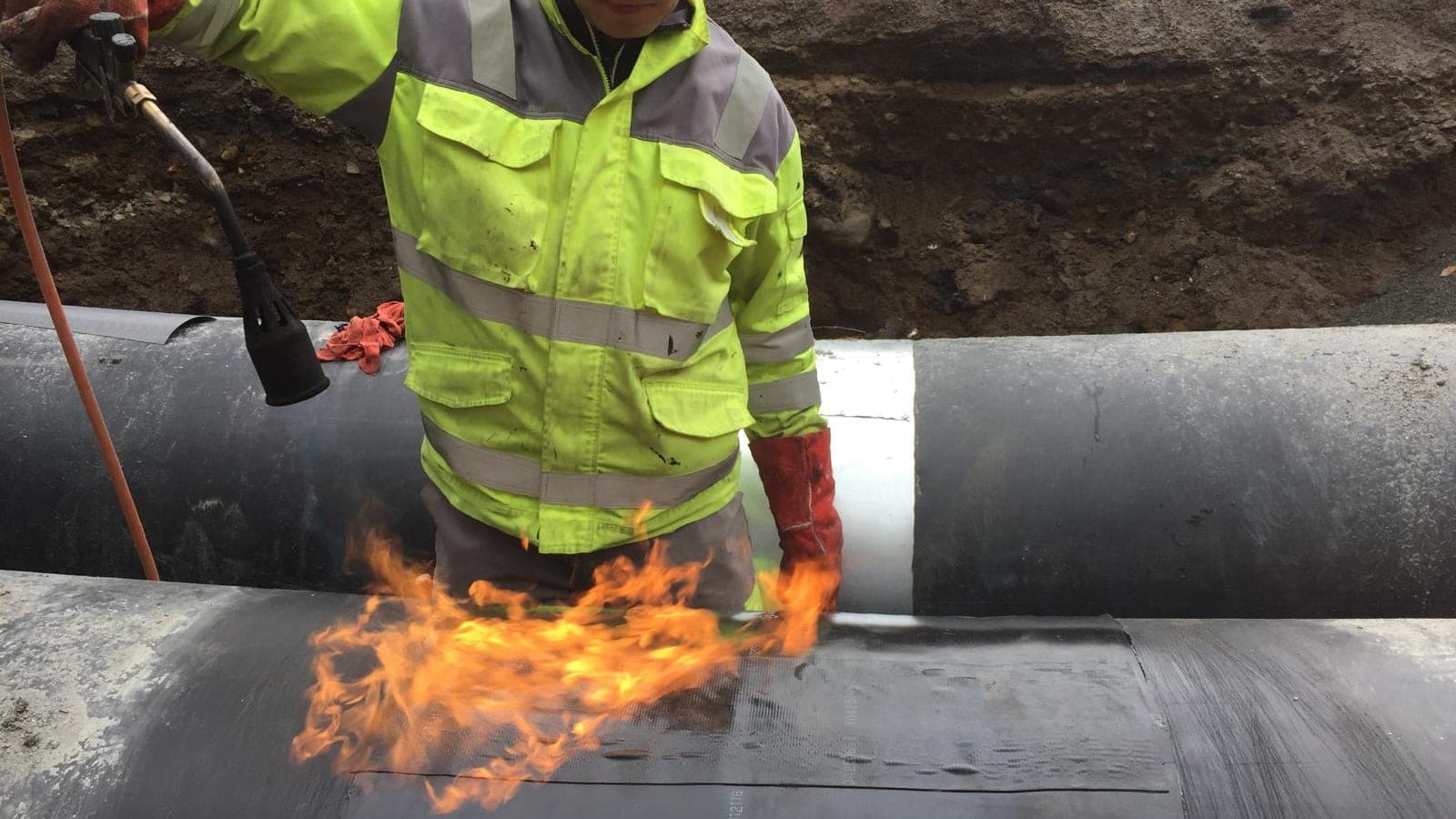
The joint of a pre‑insulated district heating pipe is sealed at the worksite, and that is exactly why it is the weakest point in the line. The factory-made jacket is sealed and tested, but in the field two pipe ends are joined, the jacket is opened and closed again, and the insulation is topped up on site.
Covalence RJS-E is one established way to seal this spot. It is a wraparound heat‑shrink sleeve that is shrunk with a flame around the joint casing. This article goes through the structure of the sleeve, the dual adhesive system, the inspection of the installation, and where the wraparound sleeve works well compared to a prefabricated muff.
RJS-E and its closure patches belong to the Covalence product family from Seal for Life Industries. Kampek supplies them to Finland and provides project-specific advice. Detailed installation instructions always come from the manufacturer.
Structure of the heat‑shrink sleeve: PE-X backing and dual adhesive
The backing of the sleeve is cross-linked polyethylene, PE-X. Cross-linking makes the polyethylene stronger and gives it a high shrink force. When the backing is shrunk, it draws tightly around the joint casing and holds its shape.
On the inner surface of the backing there are two different adhesives. This dual adhesive is the core of the whole system: each adhesive has its own task, and together they solve both adhesion and sealing. At the edges there is a high-shear hot-melt adhesive, and in the middle a viscoelastic sealant.
The PE-X of the wraparound sleeve is a different material from the PE 100 of a prefabricated muff. The PE 100 of the muff is pipe-grade jacket material, the same as in the jacket of the pre‑insulated pipe. PE-X, on the other hand, is cross-linked, because the wraparound sleeve needs a high shrink force to work.
The hot-melt adhesive at the edges anchors the sleeve in place even as the ground moves, and the viscoelastic sealant in the middle keeps moisture out from between the jacket and the pipe.Covalence RJS-E, PDS V5
Dual adhesive system: anchoring hot-melt adhesive and viscoelastic sealant
The hot-melt adhesive at the edges is a high-shear hot-melt adhesive. It holds the edges of the sleeve firmly against the jacket. This matters because the ground is alive: the soil moves and settles over the years, and the movement is directed precisely at the edges of the joint. The anchoring adhesive prevents the sleeve from coming loose due to this movement.
The viscoelastic sealant in the middle handles the actual moisture barrier. It flows into the irregularities of the surface and fills the small pits and seams on the joint casing, so that there is no path for water between the jacket and the pipe. The sealant stays flexible and does not harden, so it conforms to movement.
The division of labour is clear. The edges hold the sleeve in place against mechanical stress, and the centre keeps moisture out. With a single adhesive you would have to make a compromise between these two tasks. With two adhesives, each is optimised for its own task.
Permanent Change Indicator: how to verify a successful installation
A heat‑shrink sleeve seals only if it is shrunk to the right temperature across the entire joint area. Too little heat leaves the adhesive unactivated and the sleeve unshrunk. The problem is that, based on visual inspection alone, an under-shrunk sleeve can look finished.
For this, the backing of the RJS-E sleeve has a Permanent Change Indicator (PCI). It is an embossed pattern that disappears from the surface of the sleeve once the correct shrink temperature has been reached. Once the pattern has flattened away, the installer and the work inspector can see visually that the spot has been shrunk sufficiently.
This is a practical tool for quality assurance. The inspection can be carried out afterwards without measuring instruments: if the PCI pattern is still visible somewhere on the sleeve, that spot has been left under-shrunk and requires more heat. The pattern and how it works are described in the manufacturer's datasheet (PDS V5).
Wraparound sleeve and prefabricated muff: flexibility and scalability
The advantage of the wraparound sleeve is its wide size range. RJS-E fits casing pipes from 90 to 1200 mm, and the sleeve is supplied in widths of 230, 300, 640, 770 and 900 mm. So the same product family covers everything from small distribution pipes to large trunk lines.
Because the sleeve is wrapped on site, it also conforms to dimensions for which a prefabricated muff is not available as a standard series. This stands out in repair work and old networks, where pipe sizes and joint geometry do not always match current DN series.
A prefabricated muff, in turn, is straightforward and repeatable when the pipe size matches a standard series and the work is on a new line. The choice between a wraparound sleeve and a muff is a matter of the situation: each meets the same standard, and the solution is made according to pipe size, installation method and the site.
EN 489:2009 type testing: soil stress and water tightness
EN 489 is the European standard for the joints of pre‑insulated district heating pipes. The standard does not describe a single product. It sets the requirements that a watertight joint must meet. The key type tests are the soil stress test, in which the joint is repeatedly loaded to mimic ground movement, and the water tightness test, which verifies that the joint keeps water out from the outside.
RJS-E is type-tested to the EN 489:2009 standard at the German Fernwärme-Forschungsinstitut (FFI). FFI is an independent testing institute, and type testing means the system has been proven by the tests the standard prescribes, independently of the manufacturer's own data.
The basis of the standard is a designed service life of at least 30 years. This is a property of the standard. It is not a promise about a single product. In practice it means that the EN 489 tests are designed to match the requirements of a district heating network's long life, and a correctly installed RJS-E joint is intended to protect for the entire service life of the pipe.
Adaptability to irregular shapes: flanges, bends and fittings
A straight pipe joint is the easiest spot to seal. Harder are the spots where the geometry is not a smooth cylinder: bends, reducers and other places where the shape of the jacket changes. It is precisely at these spots that moisture gets in most easily if the seal is left uneven.
The wraparound sleeve follows the shape, because it is wrapped on site and shrunk to suit the spot. The viscoelastic central sealant fills the irregularities of the surface, which helps precisely in these challenging geometries.
The overlap seam of the RJS-E sleeve has its own closure patch, WPCP-IV, and the foam injection hole has the FOPS patch for sealing. These finish off the spots where the sleeve alone is not enough. Which patch belongs to which spot is worth confirming on a project-by-project basis. Kampek helps with the selection of accessories by phone.
Installation conditions: a dry surface and the correct shrink temperature
A type-tested product seals only if the installation conditions are right. Two things are decisive: the surface must be dry and clean, and the shrink temperature must be correct across the entire joint area. Moisture on the surface of the joint casing weakens adhesion.
The PCI pattern provides a visual inspection for this: once the pattern has disappeared, the temperature has been reached. This is a shared inspection point for the installer and the work supervisor that does not require separate measuring instruments.
The operating temperature of the RJS-E sleeve is at most 50 °C, or 60 °C under an expansion cushion. This is sufficient for the use of the current district heating network. The exact installation steps, handling of the flame and temperature control come from the manufacturer's instructions. Kampek supplies the products from the Tuusula warehouse and provides installation advice by phone, but the actual installation instructions are in the manufacturer's documents.