
In the field, surface preparation takes the most time. A traditional paint or epoxy coating requires sandblasting, dry weather, and often a primer before the first layer can even be applied. In a trench, next to a line that is in service, or in a splash zone, these conditions are not always met.
Stopaq approaches the problem from a different direction. It is a polyisobutylene-based (PIB) corrosion protection that is applied cold and stays viscoelastic for its entire service life. This text goes through what the compound physically does, why it does not require sandblasting, which standards it relies on, and when it is a more sensible choice than traditional tape or paint.
Kampek imports the Stopaq system into Finland and acts as the warehousing and advisory operator. Detailed installation instructions come from the manufacturer (Seal for Life / Stopaq). When needed, we help with selecting the application and product by phone.
What viscoelastic polyisobutylene compound physically does
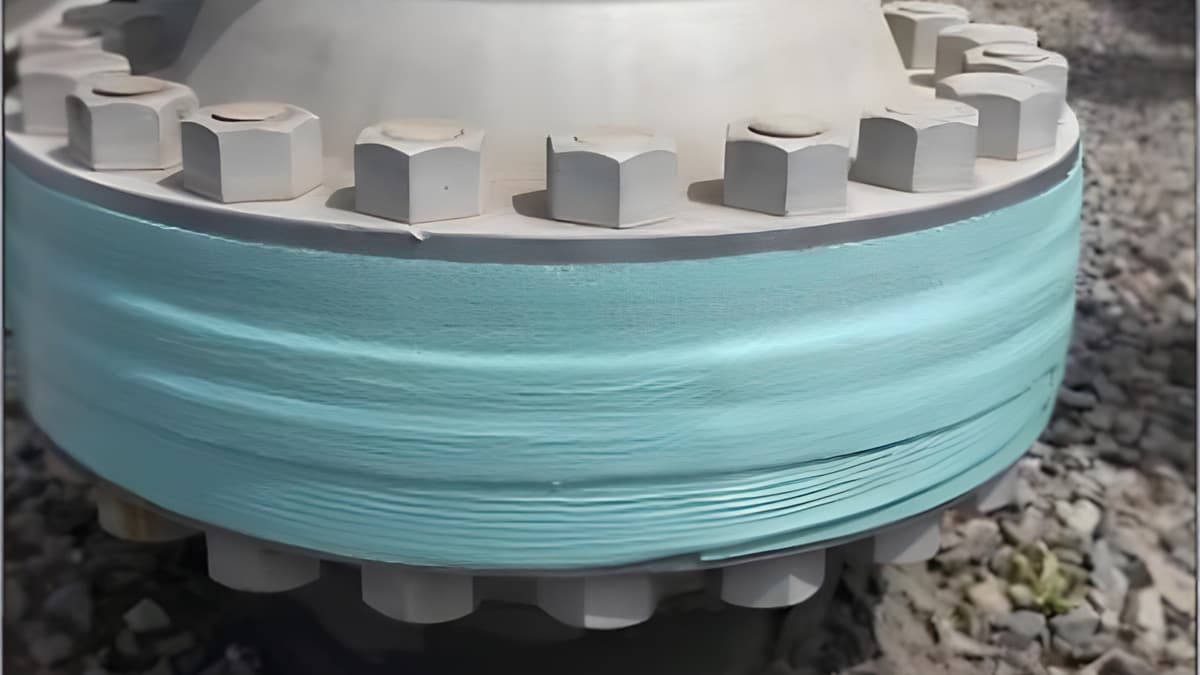
Stopaq's base product is Wrappingband CZH, a viscoelastic polyisobutylene wrap. The compound stays soft and flowable throughout its entire life cycle. No curing takes place. This is the core of the whole system. The coating moves with the steel surface and does not lock into a final shape.
Softness means the compound slowly flows into the irregularities of the steel surface and fills small pits and scratches. No air gaps are left between the protection and the steel where moisture could collect. Air gaps and a moisture pocket under the coating are precisely the mechanism that starts corrosion in traditional rigid coatings.
Outerwrap PE, a thin polyethylene tape, is applied over the Wrappingband CZH to provide mechanical protection against installation and backfill. The viscoelastic compound handles the sealing and the polyethylene tape the mechanical durability. According to the datasheet, the thickness of Outerwrap PE is 0.5 mm.
Wrappingband CZH is applied cold without a primer, and wire brushing to cleanliness grade St 2 is enough for surface preparation.Stopaq Wrappingband CZH PDS V13
What self‑healing protection means in practice
Self-healing follows directly from the fact that the compound does not cure. When the coating takes a small dent or pinpoint damage, the viscoelastic polyisobutylene slowly flows back over the damaged spot and closes the gap. A single scratch rarely remains an open path for moisture.
This is an essential difference from rigid coatings. Hard epoxy or paint cracks and tears as a result of ground movement or impact, and the tear becomes permanent. In Stopaq, the same movement does not break the protection, because the compound flexes and recovers.
It is worth keeping the wording precise. Self-healing concerns small localized damage through the compound's own flow. It does not replace a proper installation and does not heal a large mechanical tear on its own. Larger damage is repaired by patching.
Cold installation without sandblasting and primer
Stopaq Wrappingband CZH is applied cold by hand. It does not require a primer, sandblasting, or a flame. According to the datasheet, wire brushing to cleanliness grade St 2 is enough for surface preparation. In the field, this is a big difference from heavy Sa-grade blast cleaning.
The practical consequence is that in many cases the pipe can remain in service for the entire duration of the installation work. When no flame or heavy blasting is needed, the work succeeds even in tighter and more sensitive locations, such as next to a line that is in service or in a plant environment where hot work would require separate permits.
According to the datasheet, the operating temperature range of Wrappingband CZH is from minus 45 degrees Celsius to plus 70 degrees, and short-term to plus 90 degrees. This covers both underground transmission lines and warmer process pipes. Always check the temperature of the application against the manufacturer's datasheet before selecting the product.
Adhesion to bare steel and irregular shapes
The viscoelastic compound adheres directly to steel and cast iron without a separate bonding layer. Because it is soft and moldable, it conforms to shapes that a rigid wrap or a pre-bent part cannot bend to.
This solves a typical field problem. Flanges, valves, bends, and other irregular spots are hard to protect evenly with tape or paint without leaving air pockets or thin areas on the surface. Stopaq presses into these geometries and fills the profile.
Fittings and shaped parts are precisely the weakest link in a line, because uncoated spots are easily left on them. The moldability of the compound makes them easier and more repeatably protectable than with rigid systems.
Standards: ISO 21809-3, EN 12068 (KIWA) and NSF/ANSI 61
Stopaq's standards should be kept separate from the standards for district heating joints. Wrappingband CZH is tested according to ISO 21809-3:2019 (Type 13), which concerns external corrosion protection wraps for underground pipelines and cold primerless systems. In addition, it has KIWA approval according to EN 12068:2018, which covers organic coatings and external corrosion protection systems for underground steel pipelines.
For drinking water applications, Wrappingband CZH is NSF/ANSI 61 approved. This is the certification that opens use in municipal water networks, where the material must be drinking water compatible.
Casing Filler, the filler compound for the annular space of casing pipes, falls under different standards: ISO 16440 (annulus fill) and the salt spray test ASTM B117 with 720 hours of exposure. Outerwrap PE in turn corresponds to the ISO 21809-3 (Type 13A) tape type. EN 489 is not within Stopaq's scope. It is the joint standard for pre‑insulated district heating pipes (Covalence, BG Industry).
Traditional paint or tape vs. Stopaq: when Stopaq wins
A traditional rigid coating wins in a situation where the surface can be properly blast cleaned, the weather is under control, and the geometry is simple and straight. In factory conditions this is often a cost-effective approach.
Stopaq comes into its own in the field and in difficult locations: irregular shapes, a line in service, a damp or cold environment, places where sandblasting or a flame is not possible. When calculating life cycle cost, it also weighs that traditional coatings are typically renewed at fixed intervals, whereas a viscoelastic system is designed to last for decades in the ground without the same recurring renewal interval.
The durability of the product should not be expressed as a precise figure without support from the datasheet. The correct phrasing is qualitative: a long life cycle compared to traditional coatings, and protection for the entire service life of the pipe in the ground. A numerical comparison always requires a case-specific review.
Compatibility with cathodic protection and typical applications
On underground transmission lines, corrosion protection and cathodic protection usually work in parallel. According to the manufacturer, Stopaq's polyisobutylene compound does not interfere with the cathodic protection of steel structures, so both methods can be used on the same line. This is an important condition in transmission pipelines.
Typical applications are underground gas, oil, water, and steam lines, refinery and process plant pipes, offshore connections and the splash zone, as well as municipal water networks. A separately notable application is the corrosion of insulated pipes, i.e. CUI (Corrosion Under Insulation), where moisture accumulating under the insulation corrodes the steel out of sight.
Choosing Stopaq is justified when self‑healing protection and minimal surface preparation without sandblasting are needed. The temperature of the application, the drinking water requirement, and the need for cathodic protection are worth going through before ordering. Kampek helps with selecting the product and size, and the actual installation instructions and datasheets are available from the manufacturer.